Canada Trip.

Hi everyone,

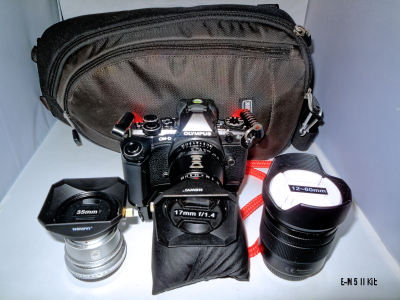
I’ve given more thought as to what gear to take with me on my trip to Canada later this year, it’s nearly forty years since I last set foot in Canada and I was substantially fitter and healthier back then. I’ve decided to pack my two lightest and smallest lenses my 14mm f/2.5 and 12-32mm f/3.5-5.6 Lumix tiny pancake lenses and Olympus PEN-F camera along with 4 filters and two spare BLN-1 camera batteries and some memory cards which fit comfortably in my small and sturdy Billingham Hadley Digital camera bag. Given the principle nature of the trip is to visit my elderly father and my sister and her family I’m going to do something that I wouldn’t normally do and pack another camera, my lightest, smallest camera, my Olympus PEN E-PL8, as a backup should anything happen to my beloved PEN-F. I’m certainly not going to take the chance of being stuck for the duration of this trip without a camera. I have a small matching detachable add-on pouch for the Billingham bag which is large enough to accommodate the E-PL8 camera, two spare BLS-5/50 batteries and a few additional memory cards. As this pouch is relatively small I’ve fitted my Olympus 15mm f/8 body cap lens. If worst came to the absolute worst then any lens is better than none. It’s not a lens that I’d relish being stuck shooting with for the duration of the trip with its small fixed aperture and poorer image quality but a heck of a lot better than nothing, “any port in a storm” as the old saying goes and a camera without a lens is about as good as a chocolate tea pot. πŸ™‚

As well as the lenses in my camera bag I’m packing three more, my Lumix 20mm f/1.7 pancake lens, my small Lumix 35-100mm f/4-5.6 zoom and an additional backup Lumix 12-32mm lens packed in my travelling tech bag alongside my usual assortment of USB camera battery chargers, charging hubs, cables, card readers, travel adapters etc. etc…The plan being that I can just take out one or maybe two small, lightweight lenses at a time to suit my requirements for the day and still be travelling comfortably light or, if I chose, I could swap cameras and use the E-PL8 for an even lighter and relatively less conspicuous carry especially of a night time. All being well I think this arrangement should work well for me. The 14mm and 12-32mm pancake lenses are, to the best of my knowledge, the smallest, lightest, multi-aperture lenses for the Micro Four Thirds system and, from experience, I’m more than happy using both. If one mounts either of them on the E-PL8 then one really has a pocketable camera.

Kind regards

Leigh

Latest thoughts and ramblings.

Hi evryone,

It’s getting ever increasingly more difficult to get the shots that I want. I’m now down to taking out just one small prime lens and pretty much the lightest of my Micro Four Thirds camera bodies. I started with prime lenses years ago and then bought several zoom lenses including my original travel zoom my Olympus 12-40mm f/2.8 PRO lens which is now far to heavy for me to take out. The lens that I need doesn’t exist and in terms of technology probably won’t exist for many years to come that’s a “standard” zoom lens that covers my preferred focal length range, mid wide angle to medium telephoto, as fast, light and compact as a standard focal length prime lens It’s a bit ironical as a standard zoom is what I need nowadays as , with my mobility problems, it avoids having to zoom with my feet or maybe that should be move with my legs but it’s not adequate as a one lens solution as I need a fast lightweight, compact lens for both day and nigh time use. So, the lens that more or less ticks the weight and speed boxes the best and covers most of my requirements albeit with its limitations is my M.Zuiko 17mm f/1.8 35mm equivalent lens. I’m missing some shots because my legs get very achy and tired very quickly on leaving the house not to mention painful by the end of the day but at least I’m getting some shots. At the risk of sounding melodramatic I’ve come close quite a few times to considering selling up my gear but something inside always stops me short of doing so.

Filters:

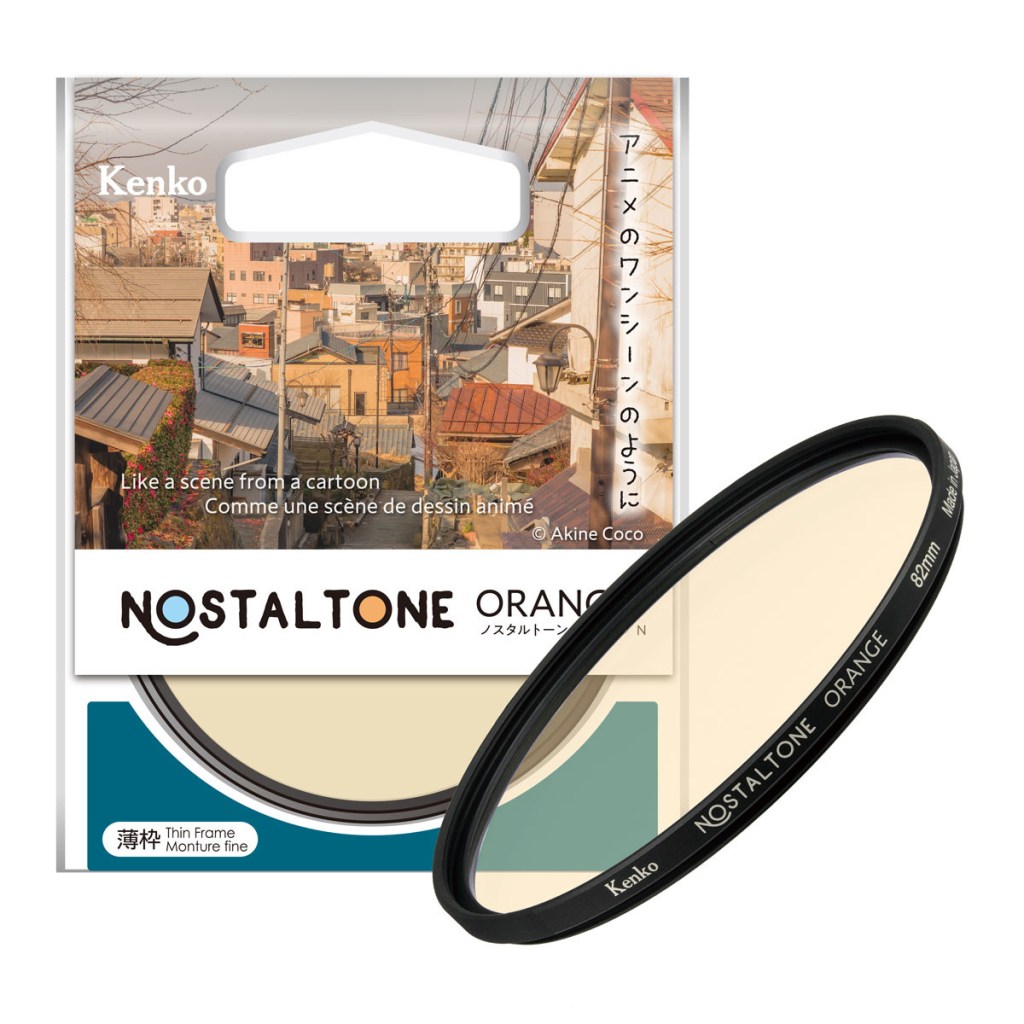
I’m not a big user of filters as I like to do most in post processing but I have narrowed it down to an absolute maximum of four filters that I’m experimenting with taking out and about with me.

Marumi Super DHG circular polarising filter. Not a filter that I need that often but useful on occasions.

Tiffen FusionPOL combined 1/4 pro black mist and CPL filter. I very rarely take portraits of people but it’s handy to have the black mist effect as well as the CPL but, for me, it’s not as useful as my other two filter below for use at night.

Kenko Black Mist #0.5. This filter has a pretty strong diffusion effect and works well if one want the halation to effect the whole image. It has it’s uses in both day and nigh time but I find my last filter give a more pleasing all round effect.

K&F Concept Shimmer Diffuser 1 filter. Unlike the black mist filter this filter is much more subdued, the halation is localised to light sources and hardly noticeable in daylight. I like this filter for nigh time use as the effect it a lot more subtle that black mist filters.

Software:

I’ve just invested in upgrading my DXO PureRAW software to the latest version 6. I’m a fan of DXO’s lens correction profiles which apart from lens distortionc correction it also includes corrections for lens-specific global sharpness and, vignetting as well as chromatic aberration correction option and, in my opinion, the best noise reduction out there and now incorprorating the DeepPRIME XD3 denoising tecnnology, The latest version also includes saving as compressed DNG format.

Kind regards

Leigh

Mobile phone photography/videography.

Hi everyone,

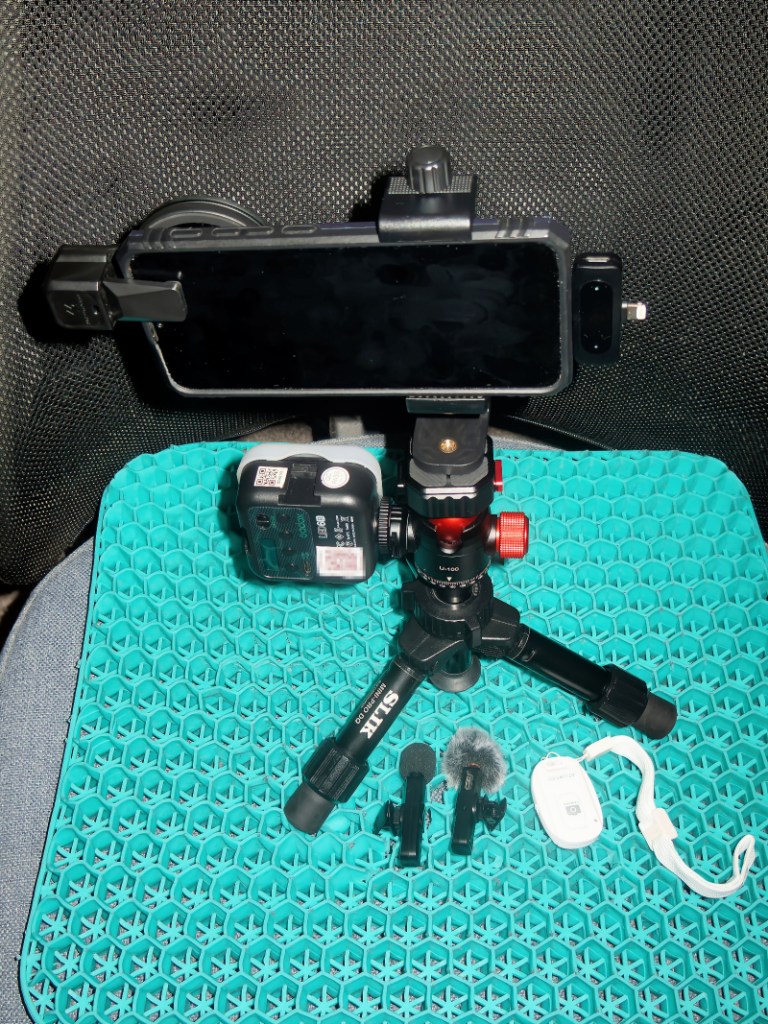
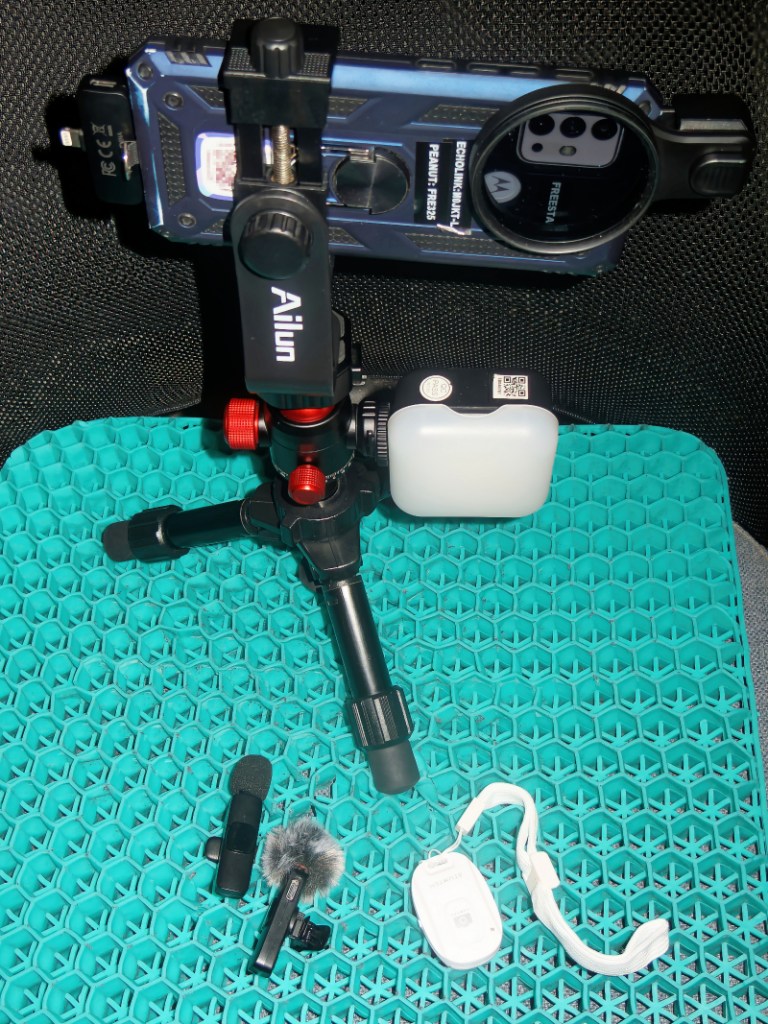
I’ve never really used my mobile phone for photography except a few family shots etc. as I’m more than satisfied with my cameras. I thought I’d try using it a bit more seriously. In order to do so I needed a few accessories. First of all I purchased an Ailun Tripod Phone Mount . this mount is much better than my old one which recently broke. It allows the phone to be rotated for landscape and portrait orientations, I like the fitting which is a screw adjustment rather than those hard to work with sprung clamp arrangements. To this I fitted one of my Ulanzi Claw quick release plates. I then attached the Ulanzi Claw U-100 ball head to a compact and lightweight but sturdy SLIK tabletop tripod base. This can also double up as a chest pod. The Ulanzi Claw ball head has a useful cold shoe mount to which I fitted on of my  Godox LITEMONS LED 6R RGB rechargeable (Type C) video lights.

To complete the accessories I purchased a set of two white and black coloured bluetooth ATUMTEK Camera Remote Shutters. as well as a K&F CONCEPT 58mm Press-on Phone Lens Filter Adapter. This comes in a nice hard case with an extra mesh pocket to take a filter and with a wrist strap lanyard and they do them to fit 58mm (my standard size) and 67mm filters but you could use the 58mm one with a step up ring if required. I’ve tried this with a CPL filter and also a black mist filter and it works well and I also fitted a screw on metal lens hood. Lastly I purchased an HMKCH Wireless Microphone Kit. In the kit you get a wireless receiver that has both USB type C and Lightning connectors, two lavalier type tie clip microphones, two of each of foam pop shield and fluffy wind shield, a charge cable and a USB A to USB-C adapter. I like that both the microphones and the receiver have a USB type C female connector for charging as I’ve standardised on this type of connector. I tested the mics and receiver on both the phone and my desktop PC (using the USB adapter) and they worked. They’re not the best quality in the world but for the price and my fledgling outing into the world of mobile phone videography they’ll do for now. Move over Spielberg. I’m coming through!. I wonder how much Jeff Bezos and Melania Trump would pay me to film the sequel?, “Melania 2 – Just when you thought it was safe to go back to the cinema”. πŸ™‚

Kind regards

Leigh

Billingham Hadley Digital camera bag, first thoughts.

HI,

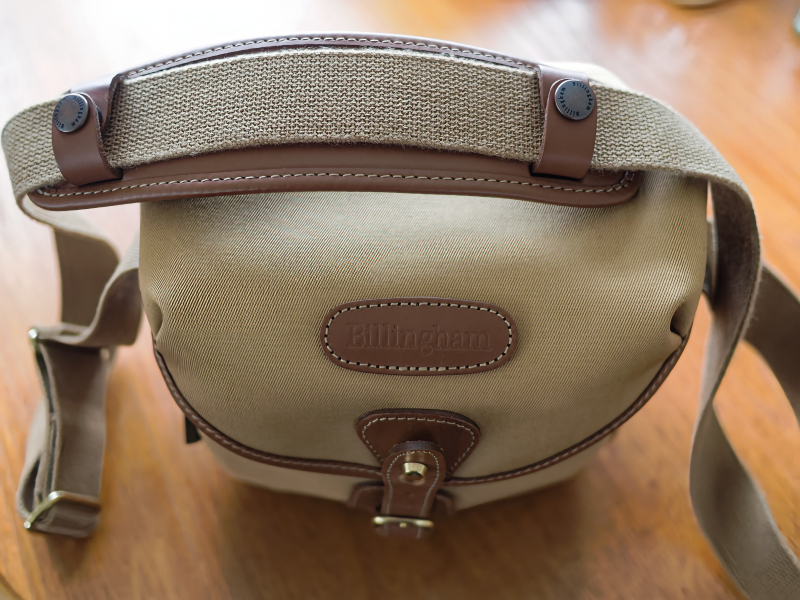
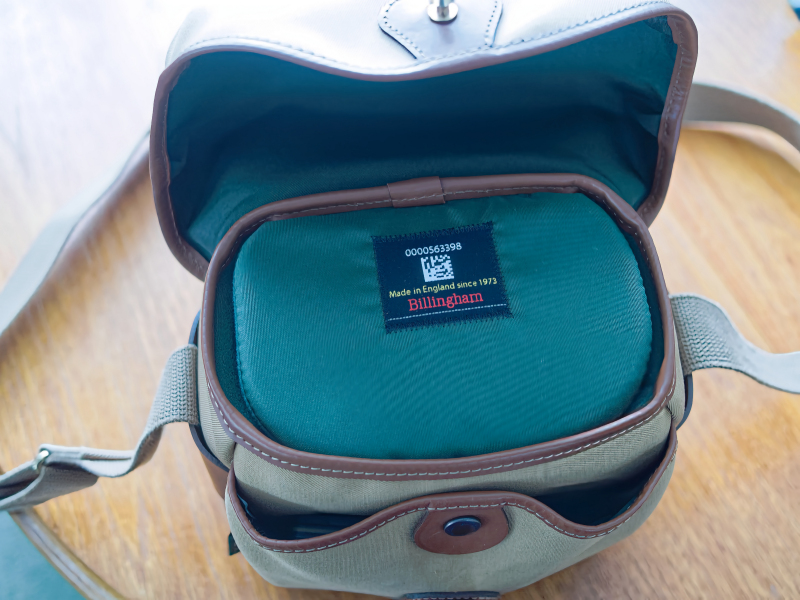
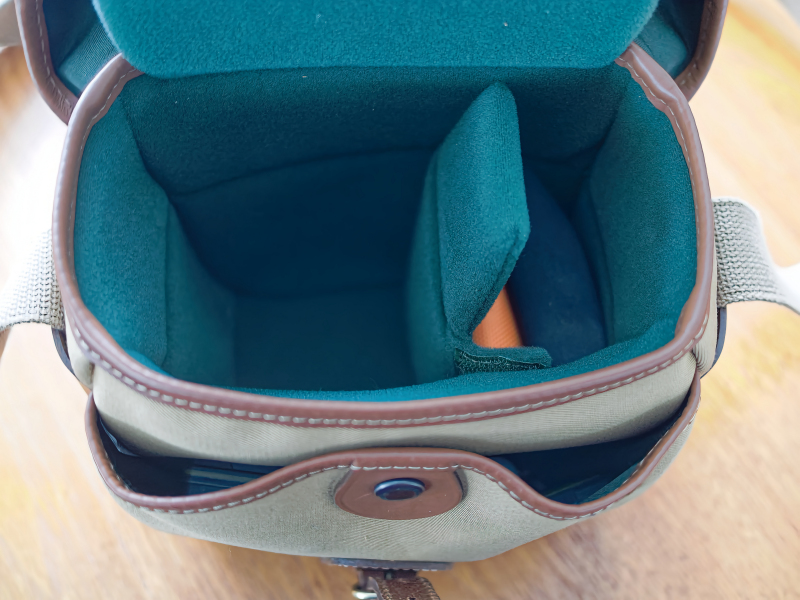
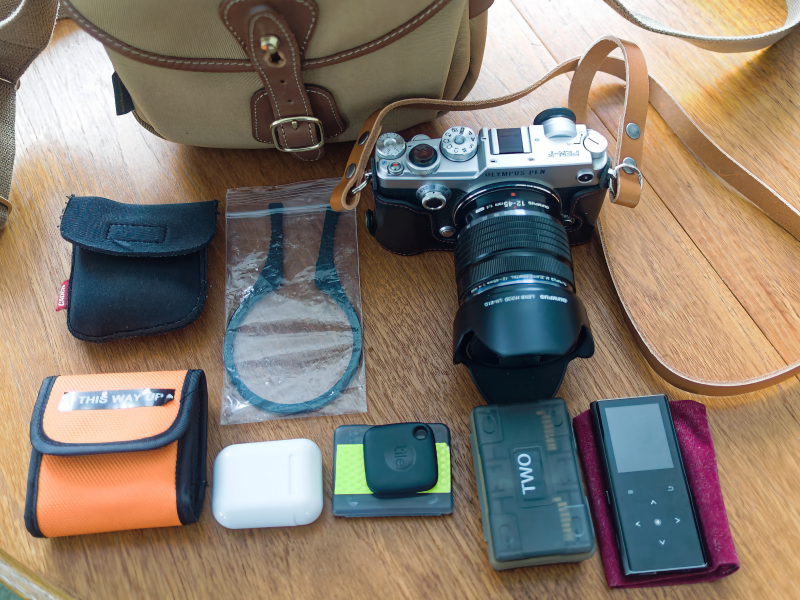
I took delivery of my new camera bag. The bag, is, as I knew it would be, superbly well made. It’s in excellent condition without a mark on it, a great second hand buy. One of the two internal dividers was missing but that doesn’t bother me for the price paid and they do spares if I choose to get more. A brilliant added bonus was the inclusion of the matching SP40 padded non-slip leather shoulder pad which, if bought as an accessory, is quite expensive. The big appeal of this bag, apart from the excellent quality of materials and manufacturing, is the extremely well padded plush interior with padded top, the good-sized front pocket which holds quite a bit and its weather proofing and it should be perfect for my day-to-day requirements, also no more zips, velcro and fiddling around fitting and removing rain covers!. I chose to try it for size with my Olympus PEN-F camera fitted with my M.Zuiko 12-45mm zoom with lens hood attached and it fits very well as the bag has some height to it which is another reason why I wanted it. Below a few shots of the bag and contents, if I was packing for a lengthier trip I’d probably squeeze in a small USB power bank and an extra spare camera battery into the front pocket and additionally pack one of my small, fast standard prime lenses in the main compartment if I get another padded divider.

PEN-F camera with 12-45mm lens attached, small four filter pouch, neoprene pouch containing lens brush, lens wipes and microfiber cloth, filter wrench as I’ve started to use filters more frequently of late, Tile Mate bluetooth tracker, spare camera battery plus two extra SDHC cards in a waterproof battery case, small cheap MP3 player and bluetooth ear buds as I occasionally like to listen to some music on my travels.

Kind regards

Leigh

I bought a Billingham Hadley Digital camera bag.

Hi,

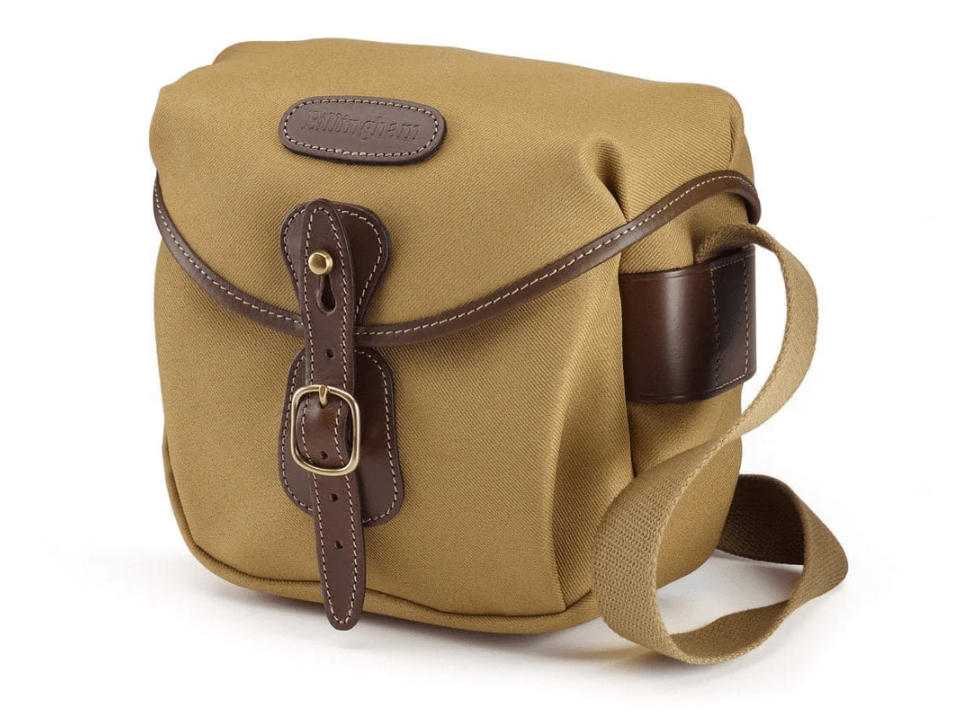
Back in the late 70s I bought one of the first Billingham 550 model camera bags ever made eagerly waiting weeks for it to be made and delivered as they were on lengthy back order such was their demand. It was a great bag, pretty large, quite heavy, but aged about twenty I was able to carry a lot more weight than I can now, it was really beautifully made and, at that time, it ticked all the boxes for me for a camera bag. It certainly wasn’t cheap even then given what I earned in those days but it was such a quality camera bag, it just screamed quality the second that one laid one’s eyes on it. I’ve been looking for a small camera bag specifically for a trip that I’m planning for later this year and I re-discovered their bags and I found one of these second hand at a very tempting price so I’ve ordered it. For my minimalistic requirements carrying just a small micro four thirds camera, one or two small lenses and a few essential accessories, spare batteries etc., I think that this bag will fit the bill very nicely. It’s pretty nigh impossible to find a bad review of Billingham camera bags, they’ve been making bags for fifty years and my experiences back then would bare this out completely. A quality UK product made from top quality materials, multi-layered waterproof canvas without the need for a separate rain cover, protective well padded interior and dividers with leather and brass fittings, arguably the best made and longest lasting camera bags that money can buy and the perfect stylish but still discrete companion to compliment my passion for retro-styled cameras and lenses πŸ™‚ with the added bonus that to anyone not in the know it doesn’t look very much like your typical camera bag.

External Dimensions: W210mm (8¼”) x D130mm (5⅛”) x H210mm (8¼”) Internal Dimensions: W180mm (7⅛”) x D100mm (4β€³) x H170mm (6¾”) Capacity: 2.50 litres (0.09 feetΒ³) Weight: 0.47 kgs (1.04 lbs)

Kind regards

Leigh

My stealthy sub Β£20 camera bag.

Hi everyone,

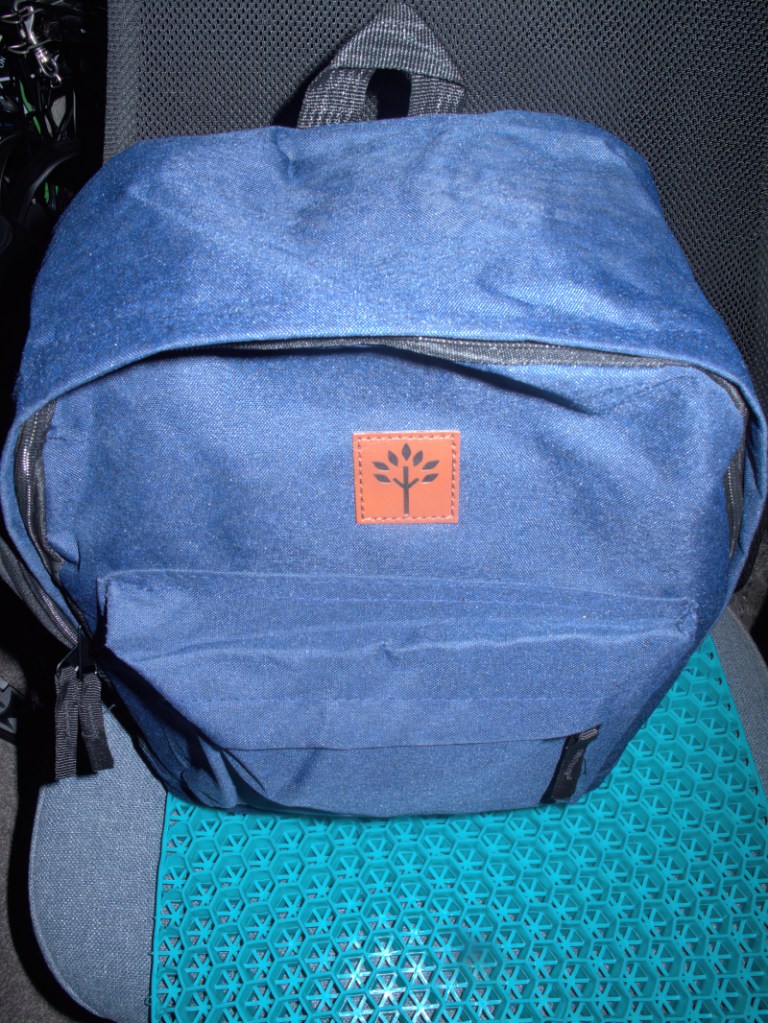
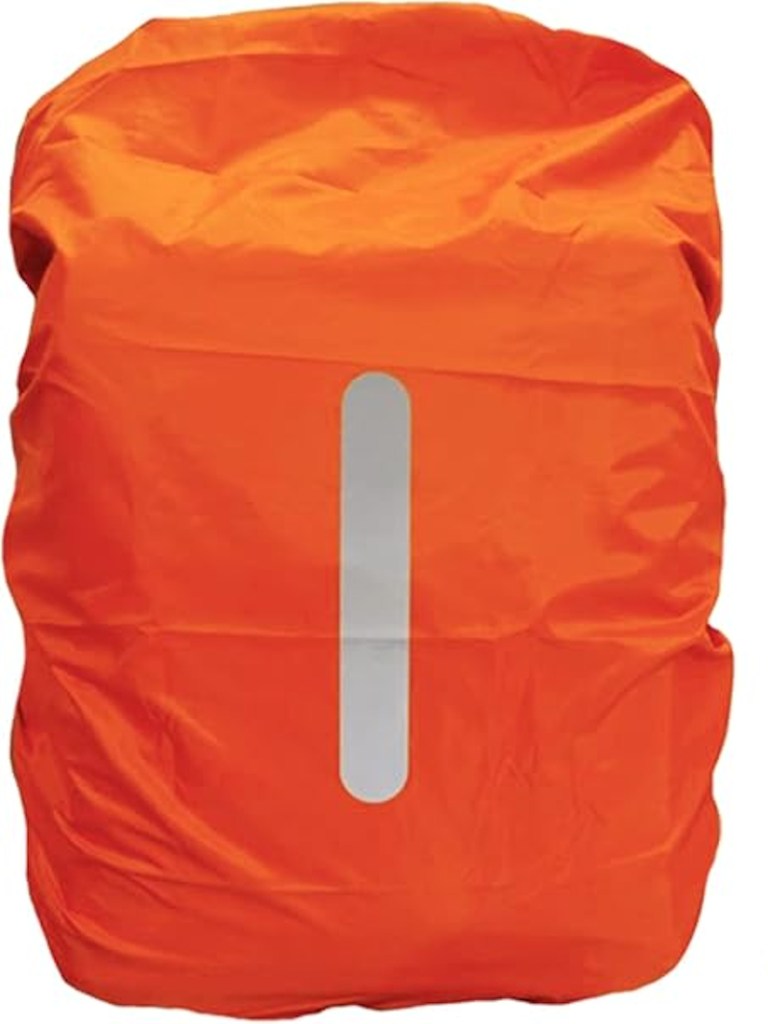
I was walking past one of those cheap shops in Bognor Regis when I spotted this small rucksack for Β£9.99 UK and I thought it would make a nice small lightweight bag. After I got it home my thoughts turned to wondering if I could adapt it to serve as an inconspicuous camera bag. I dug out a padded camera insert with a velcro fastening flap lid that I’ve had for years and it fits very nicely with some room to spare for a rolled up waterproof jacket or suchlike resting on top and my neoprene “tripod in a pencil case” fits in the mesh side drinks holder pocket. I bought a hi-vis Β£4.99 waterproof rucksack cover to fit it. So as I’m guessing that I probably spent about Β£5.00 on the insert so the total expenditure comes out at approximately Β£20.00. It’ll hold a camera and lens and one or two additional lenses and I can put a few bits and bobs such as my camera rain cover, filter pouch and spare battery/s in the front pocket. πŸ™‚ Most of all it just looks like what it is, a cheap rucksack. I’ve always liked adapting non camera bags to suit my purpose.

All the best,

Leigh

Pixis at the end of my garden! :)

Great title huh! πŸ™‚ , I was going to take a picture outside but the light’s pretty poor at this time of day so you get this one instead.

Hi everyone,

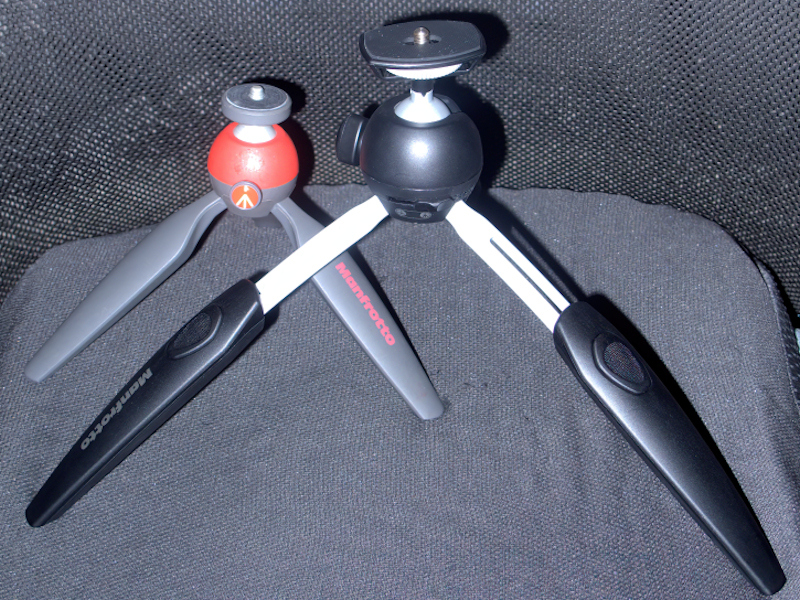
For some years now I’ve occasionally used my Manfrotto Pixi table top tripod. This little tripod has come in handy a few times. It’s small, light and pretty sturdy and best-suited for one of my smaller cameras and lenses but it has its limitations. The height cannot be adjusted and the ball head does not permit portrait orientation shots to be taken. I decided to get one of their Pixi Evo 2 tripods to address these issues. It is a bit bigger and heavier but still just small enough to slip into one of my camera bag compartments. Unlike it’s smaller sibling, the ball head is loosened and tightened by a three-sided knob rather than a hold in button. The head can be adjusted to facilitate portrait orientation shots and the legs can be adjusted individually to heighten the tripod with click stop positions, nice for uneven surfaces. There’s also a wheel with which to tighten the tripod thread unlike the Pixi which requires the whole tripod to be turned. Lastly there’s a small lever on the side which allows the legs to be adjusted to lay flat albeit significantly reducing the tripod height and having a much wider footprint. In that position, as one might expect, the tripod is extremely stable. The weight handling is claimed to be 2.5Kg which is comfortably more than enough for my cameras and all but my heaviest lenses. The tripod is heavy enough not to blow away with the slightest puff of wind. How it might hold up to the Winter winds straight from the sea on the Bognor Regis seafront is yet to be established πŸ™‚ and it might also make a nice compact chest pod.

So all-in-all a worthwhile and, as these things go, relatively inexpensive upgrade which, who knows, just might encourage me a bit more to take a tripod with me on my travels. πŸ™‚ I’d have liked to see a quick release mechanism incorporated similar to the Gorillapods but I can add one of mine but it would add extra weight and bulk, my bΓͺte noire, so for the times I foresee myself using it, I probably won’t bother at least to start with. I’m not a Vlogger but if I was and I was using the tripod as a hand grip/ selfie stick I’d probably still go with my smaller Pixi tripod as the Evo 2 is somewhat larger and heavier in one’s hand and thus grip-wise it doesn’t feel so secure unless one has somewhat larger hands than mine but because of it’s adjustable legs it does have more reach which, I guess, might be desirable.

Best wishes,

Leigh

Liberating and a lot of fun.

Hi everyone,

I’m currently going through my shots taken in Marbella. The main purpose of the trip was a close family wedding at a beautiful venue but I also managed to get a while wandering around the old town in Marbella which is very interesting and beautiful as best as my legs would allow me. I wanted to take just a camera and one prime lens so after some deliberation I decided on a little bit of a calculated gamble and just took my Olympus E-M1 mk1 and M.Zuiko 25mm f/1.8 “nifty fifty”. I wanted a camera lens combination that wouldn’t be too imposing and would be fast and versatile for both informal stand-off portraits and wider small group shots at the wedding and also a good walkabout focal length for street shots, this worked extremely well and was, especially weight-wise, absolutely liberating. I chose my E-M1 because it has the best ergonomics of all of my Olympus camera models, totally subjective but it just feel right in one’s hand.

There were a few occasions when walking around the confined narrow streets of old town when I could have maybe done with a slightly wider lens like my M.Zuiko 17mm f/1.8 or Lumix 20mm f/1.7 but not so often as to be of a concern and this lens proved a very good lightweight all round choice especially outside in low light during the evening wedding reception which went on into the night. This was the reason in particular why I decided not to take the 20mm, optically great lens as it is, it does somewhat hunt in low light and can be slow to focus on occasions when compared to the blazingly-fast Olympus lenses.. I left my new 1/4 strength K&F Concept black mist diffusion filter fitted and this gave me some very nice dreamy lighting effects as well as a degree of pleasing flattering softening for people shots.

Funny how, after the best part of fifty or so years things have more or less come full circle. I started out with a lightweight Olympus OM series film camera with only a 50mm f/1.8 lens and despite using other gear along the way I’m now steadily rediscovering the joys of using a small Olympus camera with only a 50mm f/1.8 equivalent lens. πŸ™‚

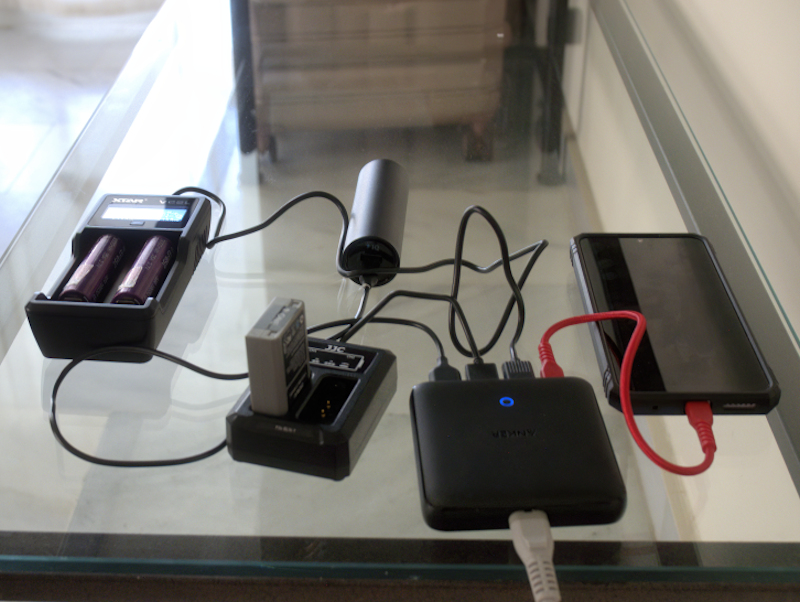
My USB charging gear worked as well as it always does, for once, we had a beautiful, spacious, modern apartment with more mains sockets than one could ever hope for! but I only need one to charge things up as required and I did have the further luxury of a table to put things on this time, it doesn’t get much better than that!. πŸ™‚

More shots of Marbella to follow.

Kind regards

Leigh

We’ve forgotten about the art of photography

Hi everyone,

I watched an interesting You-Tube video by my friend Jimmy Cheng which reinforced points made in an earlier video by Peter Forsgard. The title of Jimmy’s video being “We’ve forgotten about the art of photography“. In the videos they both made what I think are very good points which have my full agreement. The points made regard the increasing number of sites that simply review camera gear, produce test shots, test charts and pixel-peeping etc. and don’t discuss photography itself either techniques and/or by way of real world shots.

I’ve always tried to make my blog a mixture of my work, my techniques and sometimes hands-on reviews of the gear that I use especially related to my love of photography, travel and travel/landscape photography in particular and not about all the technical mumbo-jumbo which, personally, I couldn’t care less about. I’ve NEVER been asked what camera and/or lens that I used for a particular shot as folks don’t generally care about such things and why should they?.

All the gear that I use has been paid for entirely out of my own pocket and I’m not trying to sell anything. I like to share my experiences especially so when I find a technique or bit of gear that I find useful and that I think will be of interest and useful to others. In an ideal world the balance of my posts would always favour sharing my work but it’s not an ideal world and, when I cannot get out, I like to take time to share my experiences and thoughts about the gear that I’m using in the hope that it might be of benefit to someone.

Kind regards

Leigh

These are a few of my favourite (travel) things :) UPDATED.

Hi everyone,

Don’t worry I’m not about to break into a medley of songs from The Sound of Music but I could be tempted for a suitable remuneration in which case I can also supply the free loan of a pair of noise-cancelling headphones which make excellent ear defenders. πŸ™‚ Here’s some of my favourite and most useful things that I pack in my travel gear, some general and some photography-specific.

Anker 5-port USB charging hub. Travelled with me extensively and the backbone of my USB charging. Compact, metal-cased and takes an interchangeable figure of eight mains lead and has a 100-240 input voltage so will work just about anywhere in the world with a suitable cable. They do newer versions but this one has served me very well over the years and I don’t have any immediate need to change it.

Another Anker product, my newly acquired Anker Nano USB power bank which I recently posted about. I’ve always travelled with a USB power bank of some sorts and this is very small and light, with a second output port. It attaches directly to the phone so no cable required and is more or less dedicated to topping up my phone battery on the move. It doesn’t have the capacity to fully charge the phone but it does top it up quite a bit until one can get to somewhere where one can charge it normally.

I found a nice dedicated fast charging solution for my Motorola G30 mobile phone the Motorola Turbopower 50W Duo USB-C + USB-A Charger, As my travels are mostly in Europe I wanted a charger with a 2 pin European plug connection, input voltage  100-240V AC, 50/60Hz. Not only is this charger less bulky and doesn’t require a UK to EU plug adapter it also has both USB-C fast charge and USB A sockets so can act as an additional or backup charger to my Anker charger should I require it. It has therefore replaced both my Motorola UK plug phone fast charger and my travel plug adapter/ 2 port USB backup charger. A significant weight and particularly space saving in my travelling tech bag. It has USB-PD Power Delivery and Quick Charge 3.0 technologies.

Another nice thing about this charger is that it could theoretically be used to simultaneously charge my Anker Nano USB power bank and the attached phone using the power bank’s passthrough charging feature and still have an extra USB-A port to charge another device. Not something that I’ve tried out as yet but I will be doing so as it could be really useful in the event of anything happening to my main Anker USB charging hub.

JJC USB dual camera battery charger, I have two of these to suit different types of camera batteries. It has a short 15cm hard-wired built in USB Type A cable which folds away neatly and stores on the back, it’s small, light and works well. It also comes with a short 40cm USB extension cable which could be useful.

My chosen memory card and battery case. This one holds two batteries and has compartments for 5 SDHC cards as well as several micro SD cards and 2 Compact Flash cards of which I have no need so I keep a couple of lens wipe sachets in these yellow-coloured hinged compartments instead. Both battery types (BLN-1 and BLS-5/50) as fit my various Olympus OM-D and PEN series cameras fit in comfortably. It’s not overly heavy, it’s water-resistant, well constructed and gives a good degree of protection to the contents which is just about all I can ask of it. A slight cautionary note, I’ve added some prominent “This way up” labelling to the outside of the hinged lid as if, in an absent-minded moment, one inadvertently opens it upside down then everything is going to fall out!, I speak from experience . πŸ™‚ What would be nice is some form of latching bar mechanism over the batteries and cards which would prevent this from happening.

Subject of another recent post, my matchbox-sized Holux RCV-3000 USB/Bluetooth GPS data logger which is so useful for recording and subsequently geotagging the location of my shots.

Lastly another non electrical item which has come in handy on more than one occasion, my humble multitool. Everything from occasionally using the pliers or screwdriver to possibly, most importantly, opening a bottle of beer. πŸ™‚

When one only has one mains socket and not even a table to charge things on. At least the mains socket didn’t alarmingly come away from the wall when unplugging which has happened to me a couple of times on my travels, a good reason to take a USB power bank πŸ™‚ and I suppose that, looking on the bright side of life, at least I had a chair πŸ™‚

Kind regards

Leigh

Update: I’ve now had a chance to try out passthrough charging the Anker Nano power bank (USB Type-C) and my phone and also simultaneously charging two camera batteries using my JJC USB dual camera battery charger (USB Type-A) from my Motorola 50w USB wall charger. All seem to work well, so these are going in my camera bag hand luggage. πŸ™‚ These are the things that I most frequently need to charge and serving as a backup to the charging gear in the tech bag in my hold luggage should my case go missing.