My night time settings

Hiya,

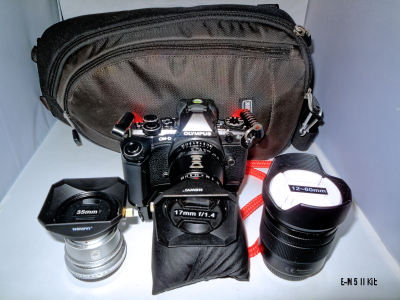
Before I started out on my two recent night time photographic adventures I took a bit of time to program into the Olympus camera’s MYSET settings two additional sets of settings, one for handheld and one for tripod-mounted, the later of which, I didn’t end up using. I took one of my fastest lenses, my M.Zuiko 17mm f/1.8. The only other thing that I took and used was my Kenko Black Mist 0.5 filter, Here’s my settings:

Handheld: (Walkabout street shooting etc.)

Auto ISO, I set the upper limit to ISO 6400 with a threshold of 1/60th second, probably could have been less at 1/30th or even 1/15th of a second thanks to IBIS and a moderate wide-angle lens but I decided to play safe. As it was I never exceeded about ISO 2000 even in the dimmest light.

All axis Image stabilisation set to on, a must unless you have very steady hands. πŸ™‚ .

Aperture Priority.

I set low speed burst mode so as to take short burst to increase my hit-rate and this worked very well.

Single autofocus with manual focus adjust (SAF/MF), a quick way of tweaking focus if required. I prefer this to using the manual focus clutch on this lens or switching to and from SAF to MF with a programmed function button.

Focus-peeking and image magnification set to on.

Aperture set when switching to this MYSET to default to the widest lens aperture (f/1.8 with the 17mm) and I can adjust it from there as desired.

Tripod-mounted: (Longer exposure landscape shots, not just for night time shots)

ISO 200

Image Stabilisation (IBIS) set to off.

Aperture Priority.

Custom self timer set to wait 3 seconds and then take 3 shots at 0,5 second intervals. I prefer this method to keep on plugging in and unplugging a cable release.

Single autofocus with manual adjust (SAF/MF)

Focus-peeking and image magnification set to on.

Aperture set when switching to this MYSET to default to f/5.6 and I can adjust it from there as desired.

Kind regards

Leigh

PS. I might also set live view boost to the 1 setting if required in very low light, pity that one cannot map this to a program button.

Let it rain, let it rain, let it rain :)

Hi everyone,

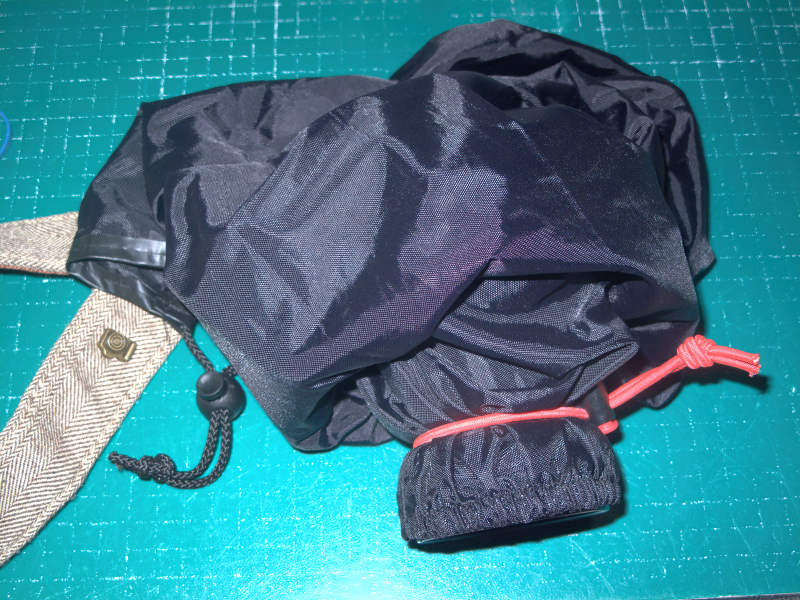
Probably the best fifteen pounds worth I ever spent on camera accessories, my camera rain cover. Used it again the other day when it was raining heavily and everything stayed bone dry. Very simple design, just a waterproof fabric funnel-shaped cover with an elasticated end at one end and a drawstring at the other. I added one of my Think Tank “Red Whips” to give it extra cinch at the lens end and prevent it slipping off of the hood. Because it’s pretty big, suited for a longer lens and my cameras are on the small side, there’s plenty of room to get one’s hand in and operate the controls and it’s also completely covers the camera when its hanging around one’s neck, I just pull it back a little and I can put my eye to the viewfinder. I also carry a clear protection filter which screws into the end of the lens hood which is quick and easy to clean and prevents rain getting in that way. Seen here with my M.Zuiko 25mm f/1.8 lens or what you can see of it. πŸ™‚ The thing that I’m most interested in protecting are my prime lenses which don’t have any weather-sealing, not that I completely trust weather-sealing in heavy rain. I prefer the peace of mind of a rain cover any day.

A tip: two things I do when caught out in the rain or if I know that I’m going to be shooting in the rain is, if it is at all possible, find a dry place to fit a fully charged replacement battery and a new memory card as you can almost guarantee that one, the other, or both will run out of capacity whilst out in the rain just when one doesn’t want it to. You really don’t want to be changing either or both in the rain or have to break off shooting and find somewhere dry to do this. Unlike some rain covers I’ve used which have to be completely removed to gain access to the camera’s battery and memory card compartments, this one just rolls back and can stay on the camera throughout. Sometimes the simplest of solutions are the best and it’s so quick and easy to fit and remove and takes up next to no room in my camera bag.

Shown without the front filter fitted .

Kind regard

Leigh

Pixis at the end of my garden! :)

Great title huh! πŸ™‚ , I was going to take a picture outside but the light’s pretty poor at this time of day so you get this one instead.

Hi everyone,

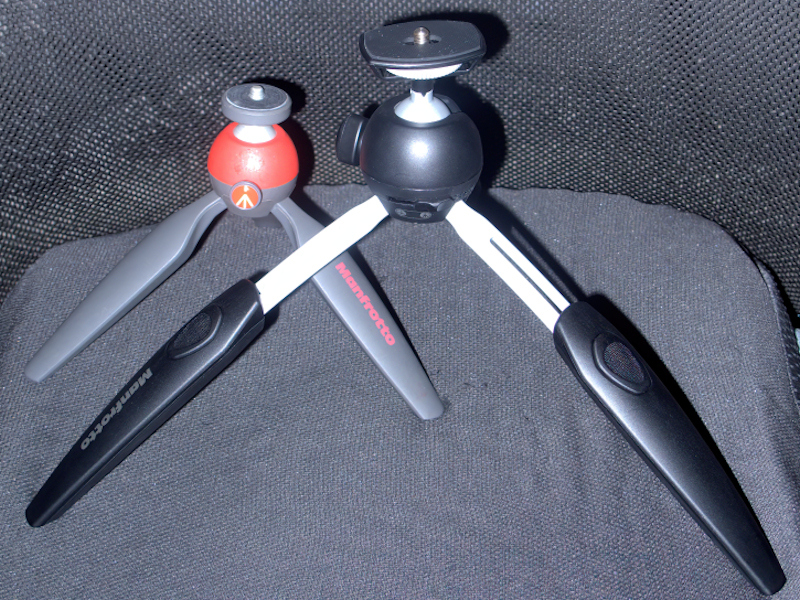
For some years now I’ve occasionally used my Manfrotto Pixi table top tripod. This little tripod has come in handy a few times. It’s small, light and pretty sturdy and best-suited for one of my smaller cameras and lenses but it has its limitations. The height cannot be adjusted and the ball head does not permit portrait orientation shots to be taken. I decided to get one of their Pixi Evo 2 tripods to address these issues. It is a bit bigger and heavier but still just small enough to slip into one of my camera bag compartments. Unlike it’s smaller sibling, the ball head is loosened and tightened by a three-sided knob rather than a hold in button. The head can be adjusted to facilitate portrait orientation shots and the legs can be adjusted individually to heighten the tripod with click stop positions, nice for uneven surfaces. There’s also a wheel with which to tighten the tripod thread unlike the Pixi which requires the whole tripod to be turned. Lastly there’s a small lever on the side which allows the legs to be adjusted to lay flat albeit significantly reducing the tripod height and having a much wider footprint. In that position, as one might expect, the tripod is extremely stable. The weight handling is claimed to be 2.5Kg which is comfortably more than enough for my cameras and all but my heaviest lenses. The tripod is heavy enough not to blow away with the slightest puff of wind. How it might hold up to the Winter winds straight from the sea on the Bognor Regis seafront is yet to be established πŸ™‚ and it might also make a nice compact chest pod.

So all-in-all a worthwhile and, as these things go, relatively inexpensive upgrade which, who knows, just might encourage me a bit more to take a tripod with me on my travels. πŸ™‚ I’d have liked to see a quick release mechanism incorporated similar to the Gorillapods but I can add one of mine but it would add extra weight and bulk, my bΓͺte noire, so for the times I foresee myself using it, I probably won’t bother at least to start with. I’m not a Vlogger but if I was and I was using the tripod as a hand grip/ selfie stick I’d probably still go with my smaller Pixi tripod as the Evo 2 is somewhat larger and heavier in one’s hand and thus grip-wise it doesn’t feel so secure unless one has somewhat larger hands than mine but because of it’s adjustable legs it does have more reach which, I guess, might be desirable.

Best wishes,

Leigh

Wake up and smell the coffee

Hi everyone,

Long term I don’t see a very rosy future for the camera manufacturers unless they wake up and smell the coffee. It seems that the only way that they can try and entice everyday folks into buying their gear is by incorporating more and more useless tech and pushing the illusion that these features will magically enable folks to take amazing photographs and/or video that their smart phones aren’t in any way capable of and, in order to do this for a shrinking market they’re making their gear un-realistically priced and un-affordable to many which is in total contradiction to selling their products and this, the size, bulk, complexity and weight of the gear isn’t going to temp that many mobile phone users into buying their gear. A camera is just that a one-use tool, one more thing to buy and carry around whereas mobile phones have many uses, they’re smaller, cheaper, easier to carry and affordable to upgrade. as well as being second-nature to operate for many, especially those of a certain generation.

The camera manufacturers need to seriously re-evaluate their strategies else they will sooner of later, probably sooner, find themselves producing ever more costly cameras for a dedicated niche market in a law of diminishing returns which can only have one outcome and those of us that enjoy using a camera will find ourselves sustained by the used camera market until we are confined to history . They’ve lost the plot, it’s not just all about how many megapixels or AI etc., it comes down to affordability, rational design and inspired marketing, look what David Bailey did for the Olympus Trip, I still have folks, old enough to remember, come up to me sometimes and say “who’d you think you are, David Bailey?” (wish I had his money) πŸ™‚ that’s clever mainstream marketing, we don’t ever see any camera adverts on TV nowadays, nothing to raise awareness, tempt people and capture their imagination so what’s to make people aware of a thing called a camera? and why they might want to buy one. What little marketing one does see is largely aimed at photographers, we know what a camera is and what it’s for, preaching to the converted!, they’re repeatedly fishing in the same small pond. Is this a mixture of arrogance and complacency on the part of camera manufacturers? if so as the old saying goes “pride cometh before a fall”. Yoshihisa Maitan’s inspirational vision to empower people with affordable, lightweight, well-built cameras to take pictures has never seemed further away.

CC. OM Systems, Nikon, Fuji, Canon, Sony et. al.. πŸ™‚

Here endeth the lesson for today πŸ™‚ πŸ™‚

Kind regards

Leigh

We’ve forgotten about the art of photography

Hi everyone,

I watched an interesting You-Tube video by my friend Jimmy Cheng which reinforced points made in an earlier video by Peter Forsgard. The title of Jimmy’s video being “We’ve forgotten about the art of photography“. In the videos they both made what I think are very good points which have my full agreement. The points made regard the increasing number of sites that simply review camera gear, produce test shots, test charts and pixel-peeping etc. and don’t discuss photography itself either techniques and/or by way of real world shots.

I’ve always tried to make my blog a mixture of my work, my techniques and sometimes hands-on reviews of the gear that I use especially related to my love of photography, travel and travel/landscape photography in particular and not about all the technical mumbo-jumbo which, personally, I couldn’t care less about. I’ve NEVER been asked what camera and/or lens that I used for a particular shot as folks don’t generally care about such things and why should they?.

All the gear that I use has been paid for entirely out of my own pocket and I’m not trying to sell anything. I like to share my experiences especially so when I find a technique or bit of gear that I find useful and that I think will be of interest and useful to others. In an ideal world the balance of my posts would always favour sharing my work but it’s not an ideal world and, when I cannot get out, I like to take time to share my experiences and thoughts about the gear that I’m using in the hope that it might be of benefit to someone.

Kind regards

Leigh

Follow up post to my Geotagging post.

Hi everyone,

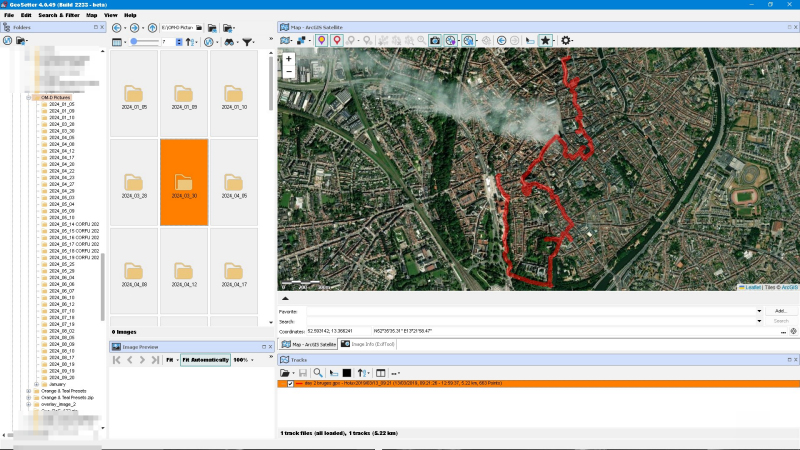
I thought I’d post a couple of example screenshots showing a track file that I recorded on my GPS Data logger when I visited Brugge some years ago. The first is from Geosetter and the second, of the same track as displayed in GPS Track Editor.

On the left one can see the list of folders containing one’s shots, select the appropriate folder and then the images can be Geotagged to the location information contained in the selected track file and displayed on the map.

On the right of the shot one can see the individual track points and one can edit these if one wishes. It also gives an indication by colour on the map of the speed of travel as well as direction of travel arrows. One can select multiple track files and overlay them on the map so if one has recorded several days of travel around an area they can be viewed at the same time.

Apart from Geotagging my shots I have a love of maps, I studied Geographic Information Systems which included Satellite Remote Sensing at University so I really enjoy viewing my travels especially on a street map at ground level in Google Earth. πŸ™‚ To give an example, when strolling around one takes a picture of a building eg. a beautiful church and one doesn’t know it’s name but can subsequently easily locate it on the map and use it when naming one’s shot which has been useful to me on numerous occasions.

Kind regards

Leigh

Camera half cases, why fit them?.

Hi eveyone,

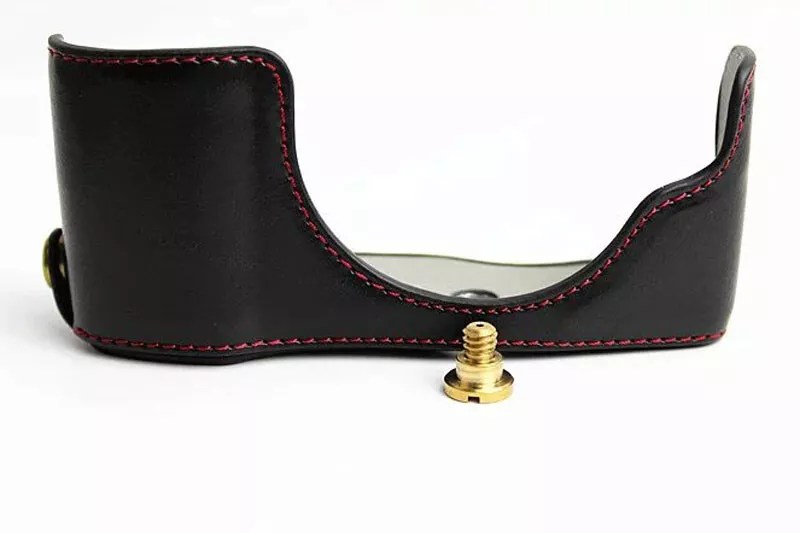
I’ve come to like camera half cases as can be seen in my previous post fitted to my Olympus OM-D E-M5 II and PEN-F camera models. I now have three, shortly to be four, of them fitted to my various camera models. For one, they add some extra protection from bumps, knocks and scuffs to the camera body as well as having a pop fastening flap for the battery compartment which proved very useful on one occasion in particular when the battery door broke on one of my cameras and I feel that they also improve the grip on the camera somewhat. They do also add a nice bit of retro styling to the camera which I like but that’s not the principal reason why I chose to fit them. I’ve also added Tile lost and found QR Code labels to the bottom of the cases as there’s nowhere on the camera bodies to attach them to. One can pick up the faux-leather ones for most models of camera on the likes of Ebay etc. and they’re quite inexpensive as camera accessories go.

If one values one’s gear, and what photographer doesn’t?, I think that fitting these is a “no-brainer” as my American friends say. Bash one of these and you can throw it away and cheaply replace it. Bash your camera body and that’s a totally different proposition with the considerable expense, inconvenience and hassle of getting it fixed always assuming that one can with out of production camera models, there’s more than a strong probability that it wouldn’t be cost-effective. At best you’ll reduce any re-sale value, at the very worst it could be a write off.

Kind regards

Leigh

Horses for my courses.

Hi everyone,

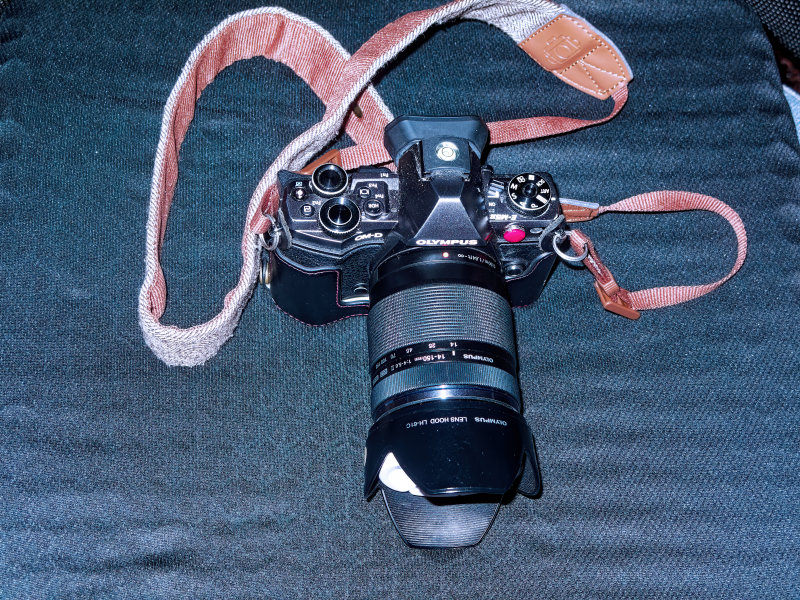
I am constantly revising and giving a lot of thought to my gear choices, partly based on experience and, unfortunately, ever-increasingly as dictated by my physical health. Below are three of my current favourite Olympus camera and lens combinations and my personal rationale for each.

Firstly, for travel, of the three, the middle weight combination my Olympus OM-D E-M5 Mk II camera and M.Zuiko 14-150mm II “super zoom” lens. Both are weather sealed with an excellent all-round focal length range without weighing me down too much. I’ve taken this camera and lens on lengthier travels and, like my other Olympus gear, they’ve performed faultlessly.

Next the lightest of my chosen camera and lens combinations, great for shorter stays and days out where I want to travel as light as possible whilst retaining as much versatility and image quality as possible, my Olympus PEN E-PL8, electronic viewfinder and M.Zuiko 12-45mm PRO f/4 constant aperture lens. Weather-sealed lens but not camera body but you probably won’t be surprised to hear that I have a suitable rain cover. πŸ™‚ This lens also has the useful added advantage of a very close focussing distance.

Lastly the heaviest of the three camera and lens combos my Olympus PEN-F camera and M.Zuiko 12-40mm PRO f/2.8 constant aperture lens, a lens which has achieved pretty much legendary status amongst Olympus Micro Four Thirds users. I’m a huge fan of this retro looking stylish camera with its 20MP sensor and the lens is the bigger and faster sibling to the 12-45mm lens and shares its build quality, weather sealing as well as having a manual-focus clutch mechanism and lens function button. Again, the body isn’t weather-sealed but I can use a rain cover if needs must. It was amongst the first MFT lenses that I bought and I used to use this lens a lot more on my travels but, although it remains a great lens, it is the heaviest of the three. Nowadays this combination is mostly reserved for “special occasions” and/or for when I feel I’m up to carrying the extra weight for any length of time.

Kind regards

Leigh

Adding a rubber lens hood to my M.Zuiko 12-45mm Pro lens.

Fully Retracted

Fully extended

Hi,

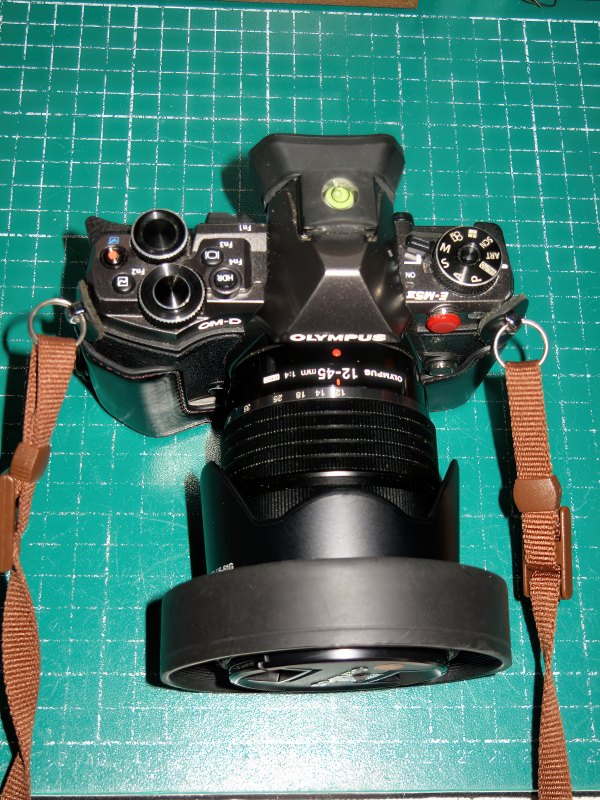
I’ve had a couple of these screw on 58mm fit three-stage collapsible rubber lens hoods laying around for ages, so long in fact that I can’t remember what I bought them for. πŸ™‚ I thought I’d try one with my M.Zuiko 12-45mm zoom lens. The advantages over the proprietary lens hood for me are two-fold. First it enables me to easily rotate the attached slim-fit CPL filter with a hood attached and secondly it works very well in conjunction with my camera rain cover which has an elasticated fitting at the lens end. I tested and, importantly, when fully collapsed, it doesn’t vignette at the wide angle end of the zoom range. Purely to save space in my bag whilst travelling I’ve left my Olympus hood attached in the reversed position at least temporarily, to act as a backup hood should I get any issues with the rubber hood. It won’t last forever but, at about Β£3-4 UK it’s cheap to replace when I need to and I already have a spare. I’ve tested it out on a couple of recent outings and it works well.

I paid about Β£17 UK new for this rain cover on Ebay a few years back. They’re made by a UK company that also make all sorts of rain covers for baby buggies etc.. So I thought they’d know more than a bit about keeping things dry and if they can keep someone’s baby dry from the rain then they can keep my “baby” dry πŸ™‚ and it does so. It’s turned out to be the best I ever used, very quick to fit with an elasticated front end which stretches over the hood to fit and can’t slip off and a draw string at the camera body end. Roomy enough to take my longest lenses and very easy to turn a zoom ring through the fabric, sometimes the simplest things work the best. Having a weather-sealed camera and lens isn’t reason enough to get it soaking wet if one has the means to keep it dry. I regard camera weather-sealing a secondary line of defence against water ingress and not a primary one.

By-the-way the camera half-case, stylish as it is, isn’t there purely for cosmetic reasons. It adds a bit more grip and protection to the camera and, having had a broken latch on the hinged battery access cover in the past before I replaced it, the flap with side fastening popper holds the battery snuggly in place should it ever fail again. Lastly, the base of the camera has a push-fit rubber cover which covers the contacts for the optional grip when not fitted. Although not overly prone to doing so it cannot fall off and get lost with the half-case fitted.

Kind regards

Leigh

Rain Gear

Hi everyone,

Along with my self-confessed obsession with lightweight camera gear goes my, borderline paranoia about keeping everything, including myself, dry in inclement weather. Okay so I guess my motto could be “be prepared” although I was never a Scout which says considerably more about me than the Scouting movement, as Groucho Marx famously said “I refuse to join any club that would have me as a member” πŸ™‚ but, moving on. Rain protection is one of those things that you either have with you and the weather turns out beautiful and you’re stuck with carrying around all day or you trust to luck and leave at home and end up cursing having done so,

One doesn’t live in the UK without possessing at least one rainproof garment and, in my case, currently, three and last Winter and this Spring have been so wet it seems like it’s rained at some stage every day since about last October. Here comes the proverbial dilemma, unless it’s raining heavily when I set off I don’t want to be stuck wearing a bulky and, should the weather turn out to become nicer, uncomfortably hot rainproof jacket. Bare in mind that I’ll be on foot most of the time and therefore there’s nowhere else to store it but on my person or in my camera bag and, however small the compact pack-a-mac type things are they’re always somewhat bulky and hard to accommodate.

So here’s my solution, some while back I bought a pack of five of those disposable plastic rain ponchos. They’re sleeved with a draw string hood and elasticated cuffs so I don’t know why they describe them as ponchos. They certainly don’t bare the slightest resemblance to the kind worn by Clint Eastwood in the Spaghetti Western films. I can keep one of them in my camera bag along with my camera and bag rain covers and it doesn’t take up any appreciable space nor add any weight. That way I have everything with me to keep myself and my gear dry if caught out by the weather, The only downside is that they make one look like a real complete and utter prat but, when it comes to such things, I have no shame! and my trendy clothing days are, I’m sorry to say, well and truly behind me so I’d rather look like a dry prat than a drowned rat, πŸ™‚